The world atlas

Rugs from Türkiye to the Silk Road.

The rug belt runs from the Aegean coast of Türkiye through the Caucasus and Iran to Central Asia. Every town and tribe along it has its own knots, colors and motifs. Here are sixteen to know.

Map from Türkiye to Uzbekistan with 16 rug and weaving traditions pinned by town Numbered pins mark where each tradition comes from. The colors follow the key below the map, and the numbers match the list. TÜRKİYE IRAN IRAQ SAUDI ARABIA SYRIA TURKMENISTAN UZBEKISTAN AFGHANISTAN BLACK SEA MEDITERRANEAN SEA CASPIAN PERSIAN GULF 1 2 3 4 5 6 7 8 9 10 11 12 13 14 15 16
Anatolian rugs and kilimsPersian rugsCaucasian and Central Asian Numbers match the list below. On a phone, swipe the map sideways. Map data: Natural Earth.

Sixteen rugs and weavings, town by town.

Each illustration is drawn by Atlasana from the traditional designs. Real pieces vary from maker to maker, and every region has far more styles than we can show here.

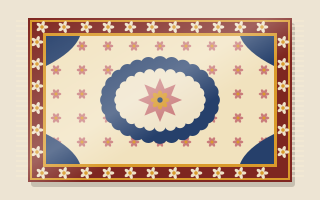
Hereke silk rug: an ivory and gold field of tiny flowers around a blue lobed medallion, with a red floral border and a silky sheen
1Anatolian rugs and kilims

Hereke

Hereke, Kocaeli, Türkiye

Silk rugs from a town on the Sea of Marmara, where an imperial workshop was set up in the 1840s to furnish the Ottoman palaces. Hereke rugs are known for very fine knotting, delicate floral designs and a soft sheen.
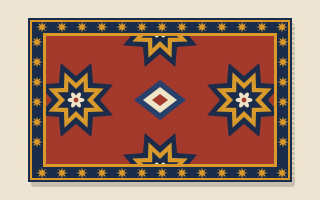
Star Uşak carpet: large blue eight-pointed stars with gold outlines on a madder red field, and a blue border
2Anatolian rugs and kilims

Uşak

Uşak, western Anatolia, Türkiye

One of the great carpet centers of the Ottoman era. Star and medallion Uşak carpets of the 1500s were traded to Europe and appear in Renaissance paintings, and the town still weaves large rugs today.

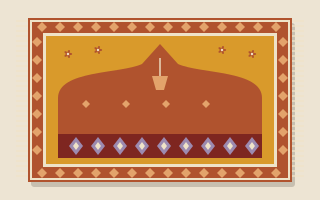
Milas prayer rug: a rust red niche with a pointed arch and a hanging lamp on a gold ground, with lilac diamonds and an apricot border
3Anatolian rugs and kilims

Milas

Milas, Aegean coast, Türkiye

Village rugs from southwest Türkiye, often prayer rugs with a pointed niche, woven in warm shades of rust, apricot and gold.

Konya kilim: flatwoven bands of hooked diamonds in red, ivory, gold, green and navy
4Anatolian rugs and kilims

Konya kilim

Konya, central Anatolia, Türkiye

Flatwoven kilims with bold hooked diamonds and stepped bands. Konya is also home to some of the oldest known Turkish carpets, Seljuk-era pieces found in the city's Alaeddin Mosque.

Kazak rug: three bold octagonal medallions in green and navy with stepped centers on a bright red field
5Caucasian and Central Asian

Kazak

Gazakh, South Caucasus

Village rugs from the borderlands of today's Azerbaijan, Armenia and Georgia. Kazak rugs have large, bold geometric medallions, glossy long wool and bright reds, blues and greens.

Kuba rug: a dark navy field packed with small stars, diamonds and squares in red, gold and teal, inside a white border
6Caucasian and Central Asian

Kuba

Quba, Azerbaijan

Finely knotted rugs from the northeast Caucasus, with dark fields packed with small geometric motifs and crisp, often white-ground borders.

Tabriz carpet: a red and navy lobed medallion with pendants on an ivory field of scrolling vines, with navy corners and a red border
7Persian rugs

Tabriz

Tabriz, northwest Iran

One of the oldest and largest weaving centers in Iran, around a vast historic bazaar. Tabriz workshops weave almost every style, from classical medallions to pictorial rugs, usually with the symmetric, or Turkish, knot.

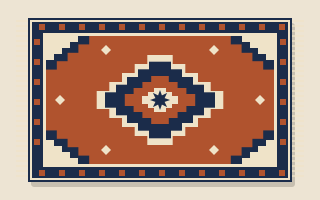
Heriz rug: a large angular stepped medallion in navy, ivory and rust filling a rust red field, with stepped navy corners
8Persian rugs

Heriz

Heris, northwest Iran

Village rugs from the hills east of Tabriz, with large angular medallions in rust, navy and ivory. They are prized for their durability and thick, hard-wearing wool.

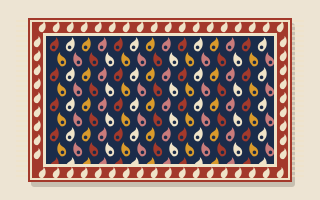
Senneh rug: rows of tiny paisley-like boteh in red, ivory and gold on a deep navy field, with a red border
9Persian rugs

Senneh

Sanandaj, Iranian Kurdistan

Very fine, thin rugs and kilims, often covered in a small repeating boteh, the teardrop shape known in the West as paisley. The asymmetric Persian knot is often called the Senneh knot, though Senneh weavers mostly use the symmetric one.

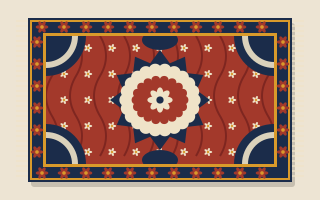
Kashan carpet: a navy star medallion with ivory and red centers and pendants on a deep red floral field, with navy corners
10Persian rugs

Kashan

Kashan, central Iran

A city with a long history of silk and fine carpet weaving. Kashan rugs are known for classical designs around a central medallion, deep reds and navy, and dense, velvety wool.

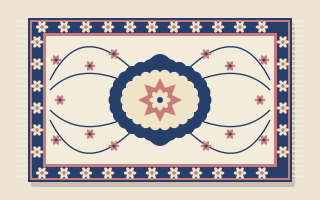
Isfahan rug: a symmetrical blue and rose floral medallion on an ivory field of scrolling vines, with a blue border
11Persian rugs

Isfahan

Isfahan, central Iran

Capital of Safavid Persia under Shah Abbas, when the court workshops flourished. Isfahan still weaves some of Iran's finest rugs, with balanced floral medallions in ivory, blue and rose, often on a silk foundation.

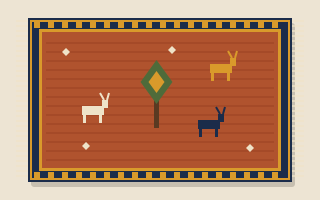
Qashqai gabbeh: a thick rust red rug with an open field, a simple tree and three little goats in ivory, gold and navy
12Persian rugs

Qashqai and gabbeh

Fars province, southern Iran

The Qashqai, a nomadic Turkic-speaking people, weave lively tribal rugs and kilims. Gabbeh are thick, soft rugs with long pile, open fields of color and a few simple figures like animals and trees.

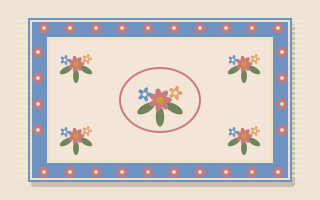
Kerman rug: soft floral bouquets in rose, sky blue and apricot on a pale field, with a wide border of flowers
13Persian rugs

Kerman

Kerman, southeast Iran

City rugs known for flowing floral designs, wide borders and a broad range of soft colors. Kerman weavers became famous for elaborate garden and pictorial designs.

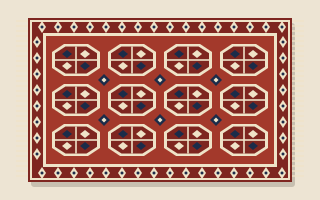
Turkmen rug: rows of quartered octagonal guls in ivory and navy on a deep red field
14Caucasian and Central Asian

Turkmen

Turkmenistan

Deep red rugs with rows of gul, the octagonal emblems that set one tribe's weaving apart from another's. In the trade they are often sold as Bukhara rugs, after the market city where many were once traded.

Suzani embroidery: large red sun disks with gold stitching and green vines on a cream cotton ground
15Caucasian and Central Asian

Suzani

Bukhara, Uzbekistan

Not a rug but an embroidered hanging. Suzani are stitched in silk on cotton with large sun and moon disks and flowering vines, and were traditionally made for a bride's dowry.

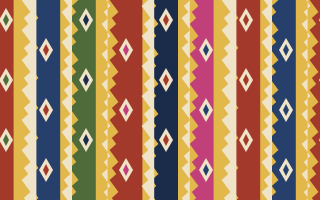
Margilan silk ikat: vertical bands of red, indigo, green and magenta with feathered, flame-like edges on a yellow ground
16Caucasian and Central Asian

Margilan ikat

Margilan, Fergana Valley, Uzbekistan

Silk ikat, known as khan atlas, with blurred, flame-like patterns made by dyeing the threads before weaving. Margilan sits on the old Silk Road and still has working silk mills.

Keep exploring the atlas.

Make, sell or buy. Start here.

Tell us which side you're on and what you're looking for. A real person reads every email and replies within one business day.